
Cafes, hotels take swipe at $1.6b consumer card fee win

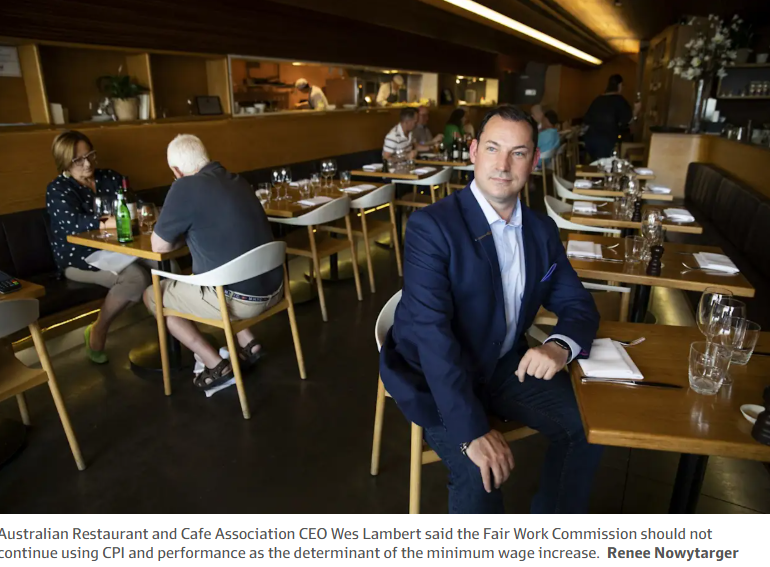
Consumers wouldn’t save any money when eating out and would be the biggest losers from the change, Australian Restaurant and Cafe Association chief executive Wes Lambert said.
RBA bans credit and debit card surcharge despite business disquiet

“Small restaurants and cafes will not be able to pass on merchant fees they continue to pay banks and payment providers. We expect menu prices will increase on October 1 and for any business that does not pass costs on, their profit will drop,” said Australian Restaurant and Cafe Association chief executive Wes Lambert. “Consumers will now pay $5.10 for a coffee that used to cost them $5.08, and the biggest losers are cash payers.”
Hospitality operators urged to introduce a temporary surcharge on breakfast, lunch and dinner services due to the fuel crisis

The Australian Restaurant and Cafe Association has urged hospitality operators nationwide to introduce a temporary surcharge on breakfast, lunch and dinner services to cover higher expenses they were copping to plate up meals.
Employers back 3.5pc increase in minimum wage amid inflation warning
Employers and high-profile restaurateurs have backed a minimum wage rise aligned with inflation for 2.6 million workers, warning that anything above the consumer price index risks making the economy unsustainable.
Government to slash red tape as record numbers of Sydney cafes and restaurants fail

“Restaurants and cafes are closing at a rate of one in 10 … and have some of the lowest profit margins in the country,” Australian Restaurant & Cafe Association CEO Wes Lambert said. Mr Lambert called for a “hospitality-specific” liquor licence category and for outdoor dining fees to be permanently scrapped.
Are Friday night drinks a distant memory? How work-from-home and the four-day work week is hitting CBD cafes and pubs

Australian Restaurant and Cafe Association (ARCA) chief executive Wes Lambert warned it might be too late for CBD businesses to claw back pre-COVID-19 foot traffic.
He is unsurprised that some venues are choosing to close on weakening sale days.
The peak hospitality industry boss said owners may want to capitalise on Thursday night customers instead.
Cafe’s under pressure

New data highlighted by the Australian Restaurant & Cafe Association (ARCA) shows 10.4 per cent of cafés and restaurants shut their doors in the past 12 months. By comparison, pubs, clubs and bars recorded failure rates of about eight per cent.
ARCA chief executive Wes Lambert said the sector was facing structural – not temporary – pressures. “This is not cyclical. This is policy-driven pressure layered on top of weak consumer confidence,” Mr Lambert said.
NSW’s Anzac Day long weekend plan: Small hospitality businesses urged to close

The decision will lift labour costs for hospitality venues to 75 and 100% of sales, Australian Restaurant & Cafe Association chief executive Wes Lambert warned.
“So we’ll be encouraging cafes and restaurants not to open,” Lambert told ABC TV.
“Hospitality businesses are on some of the lowest profit margins in history, below 3%, and they just cannot wear another public holiday in NSW.”
NSW to receive extra public holiday

Australian Restaurant and Cafe Association chief executive Wes Lambert cautioned small businesses against opening, saying, “Hospitality businesses are on some of the lowest profit margins in history, below 3%, and they just cannot wear another public holiday in NSW” (SBS).
A wave of restaurant closures looms—what three in 10 cutting back means for your favourite spots
The numbers paint a grim picture. According to the Australian Restaurant & Cafe Association (ARCA), one in nine hospitality businesses went insolvent in 2025.
Profit margins have shrunk to razor-thin levels: 2.8 per cent for restaurants and 2.6 per cent for cafes.
Wes Lambert, chief executive officer of ARCA, puts it bluntly:
‘Ultimately, when you have inflation at such a high level, consumers have to make a choice. They have to choose paying their mortgages and their bills or dining out.’